


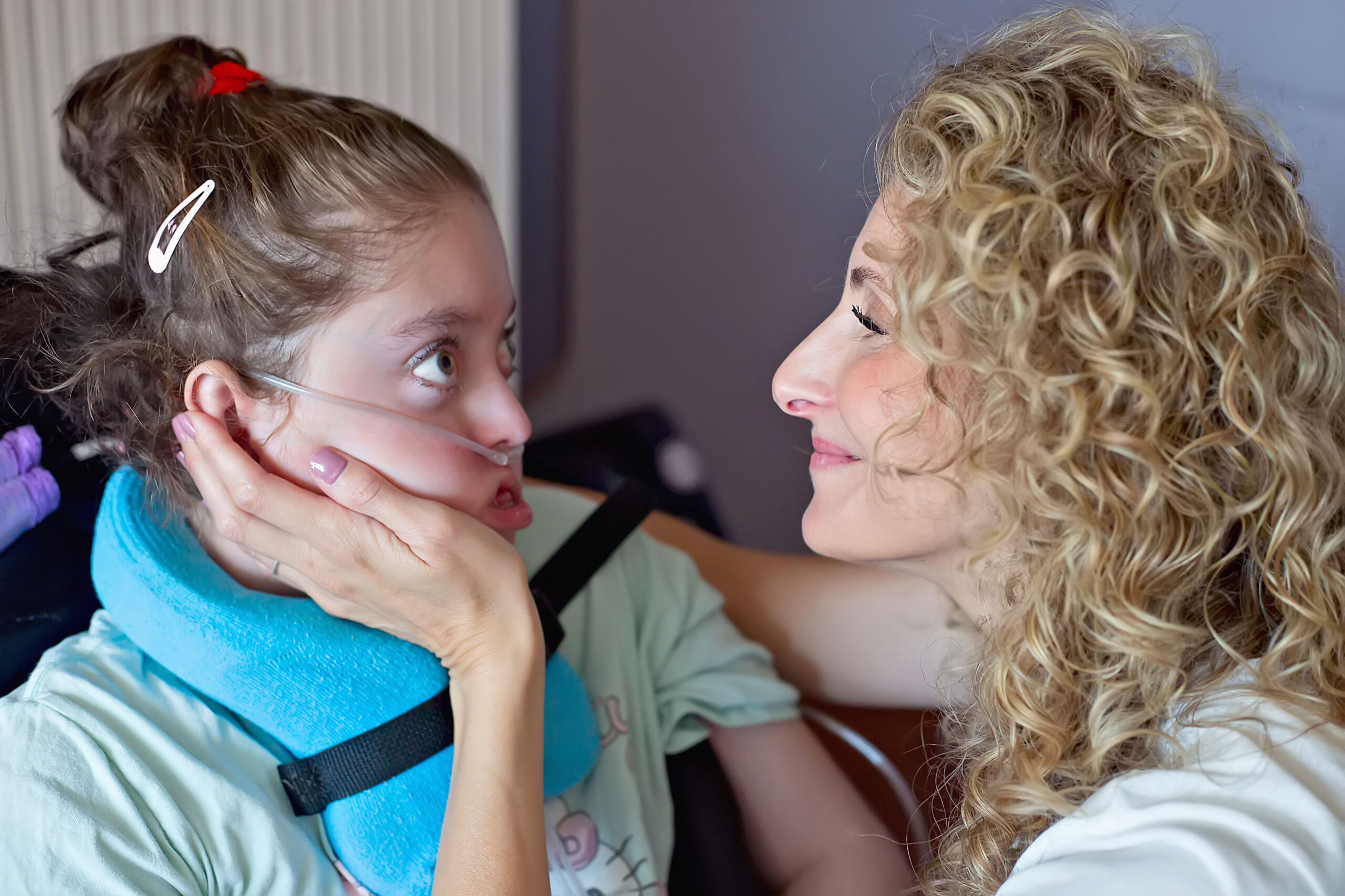
There is a strange thing that happens when you have been parenting a medically complex child for a long time. You get good at it. Really good at it. And sometimes “good at it” doesn’t begin to describe the depth of knowledge families develop.
Over the years, our knowledge of Gabi’s respiratory care has grown to overlap with knowledge and skills that would ordinarily sit across several professional disciplines—nursing, respiratory therapy, physiotherapy, and, in some areas, medicine.
We perform Gabi’s chest physiotherapy, suction her airway, manage secretions, respond to acute respiratory events, and routinely manage significant desaturations, sometimes into the 50s and 60s. We understand her BiPAP settings, respiratory rate, oxygen saturation, heart rate, airway-clearance needs and, perhaps most importantly, how all of those pieces interact for her. We know Gabi’s respiratory patterns intimately—from changes in her secretions and breathing to how she responds to positioning and airway-clearance techniques. We recognize when something is developing, know which interventions typically work for her and in what order, and can often manage significant respiratory crises ourselves, while also knowing when additional support is needed.
This is more than knowing how to perform a collection of tasks.
It is years of technical knowledge layered with something healthcare professionals cannot acquire from a textbook or a shift at the bedside: an extraordinarily detailed understanding of one individual child’s physiology. That distinction matters.
Eventually, healthcare professionals recognize that you are capable too. That recognition can be incredibly important. Parents of medically complex children often fight for years to have our knowledge taken seriously. We want healthcare professionals to recognize that we know our children in ways no one else can. But there is another side to being seen as capable that we don’t talk about nearly enough. Sometimes, the more capable we become, the less support we receive.
A bed change that wasn’t really about a bed change
During a recent hospitalization, my husband and I had just spent almost an hour performing Gabi’s chest physiotherapy ourselves. This isn’t unusual for us. It is part of her daily care at home and something we routinely continue doing in hospital.
That evening, after finishing her treatment, we realized her bedsheets needed to be changed. There were three capable people in the room: my husband, one of Gabi’s home nurses, and me.
The hospital nurse brought us clean linens and left.
It was such a small thing. And yet, standing there exhausted after weeks in hospital and nearly an hour of providing physically demanding care ourselves, it didn’t feel small. Because what I realized in that moment was this: She saw three capable people. What she couldn’t see was what those three people had already carried. She couldn’t see how tired we were. She couldn’t see the care we had already provided that day. She couldn’t see the accumulated weight of weeks spent watching monitors, responding to alarms, managing respiratory events, providing treatments, advocating, making decisions, and remaining constantly alert for the next change.
She saw capacity. And capacity became: They’ve got this.
Victims of our own competence
I have thought about this phenomenon a lot.
In some ways, families like ours can become victims of our own competence. The more healthcare professionals see what we can manage, the easier it can become to assume that we will simply continue managing it. And this is where something subtle can happen. Expertise that should strengthen partnership can instead begin to shift responsibility.
Because we know how to perform Gabi’s chest physiotherapy, we do it. Because we know how to manage her airway, we step in. Because we recognize her respiratory patterns quickly, we respond. Because we know what usually works when she begins to deteriorate, we act. And because we act, others step back.
The same thing can happen when a child’s home nurse comes into hospital. Their presence can create a similar assumption: There’s a nurse in the room. They’ve got it. But not every home nurse has the same training, experience, or comfort with every aspect of a child’s care. And even when they are highly skilled, their presence does not transfer responsibility for hospital care onto them.
There is a difference between having the ability to provide care and having the responsibility to provide all of it. And there is an even greater difference between being capable of something and having unlimited capacity to keep doing it.
Partnership is not substitution
I want healthcare professionals to recognize our expertise. I want them to ask us what is normal for Gabi. I want them to believe us when we say something is different. I want them to recognize that sometimes we may be the people in the room with the deepest understanding of how a particular respiratory event typically unfolds for her. I want them to value the knowledge of the home nurses who know her well. I want to participate in her care.
I don’t want healthcare professionals to push us aside and tell us to simply be the parents. Our knowledge has been hard-earned, and it matters. But there is a difference between empowering families to participate in care and quietly shifting the responsibility for that care onto them when their child is hospitalized.
True partnership does not mean: You know how to do this, so we’ll let you do it all.
It means: You know your child. We bring our professional knowledge and responsibility. Let’s do this together.
Our expertise should complement the expertise and responsibilities of the healthcare team. It should never replace them.
I can wear many hats. I cannot wear all of them all the time.
Parents of medically complex children often wear an extraordinary number of hats. I am Gabi’s mother. I am her caregiver. I am her advocate. I support her physical and developmental needs. And over many years, I have developed a level of knowledge about her medical and respiratory care that has become another part of how I keep her safe. I can move between those roles almost automatically. But I cannot occupy all of them at full capacity all of the time.
Sometimes I need to just be her mother. Sometimes I need someone else to perform the task I am perfectly capable of performing. Sometimes I need someone else to watch the monitor. Sometimes I need someone else to respond first. Sometimes I need to trust that if I leave the room, someone else is carrying the clinical responsibility. And sometimes, after spending almost an hour providing complex, physically demanding respiratory care, I just need someone to help me change the sheets.
That does not make me less capable. It does not make me less knowledgeable. And it certainly does not make me less willing to care for my daughter. It means I have reached the limit of what I can carry in that particular moment.
The smallest offers can matter the most
Some of the most meaningful moments I have experienced in hospital have not involved complicated medical interventions. They have been small moments of recognition.
“Go get something to eat. I’ve got her.”
“Do you want me to do this?”
“I’ll help you turn her.”
“Why don’t you go sleep for a while?”
“Do you need a hand?”
“I’ve got this one.”
Those words can feel enormous when you have been carrying responsibility for days or weeks. Because what they really communicate is:
I see how much you’re carrying.
You don’t have to carry everything.
You are allowed to need help.
There is something deeply relational about that. It isn’t simply about completing a task. It is about recognizing that the person who appears incredibly capable may also be exhausted.
When competence makes it harder to leave
There is another consequence when healthcare professionals begin relying heavily on capable families.
We stop feeling able to leave.
This is perhaps one of the hardest parts to explain. If I believe that my presence changes the level of attention or expertise available to Gabi, stepping away becomes difficult. If I know that I may recognize a respiratory change sooner, initiate the intervention, manage the airway, or understand what a combination of numbers and clinical signs means for her, what happens when I am not there?
If a home nurse is present, can I trust that hospital staff understand exactly what that particular nurse can and cannot manage? Will someone come into the room if Gabi desaturates, or will they assume the person beside her has it under control? Too often, our experience has been the latter.
Those questions make rest incredibly difficult.
So families stay. We postpone meals. We sleep beside the bed. We organize our lives around who can be physically present. We become reluctant to leave even when we desperately need a break.
And over time, the very expertise that makes us valuable members of the team can become the reason we feel unable to step away from it.
That is not sustainable partnership.
Ask instead of assume
Perhaps one of the simplest things healthcare professionals can do is ask rather than assume.
Don’t assume that because a parent is highly skilled in their child’s care, they want—or have the capacity—to perform every intervention. Don’t assume that the presence of a home nurse means hospital nursing support is no longer needed. And don’t assume that because a family managed the last respiratory crisis, they should automatically manage the next one.
Sometimes we will want to take the lead. Sometimes we will want to work alongside you. And sometimes we will need you to step in and take over.
The important thing is not to assume which one it is.
Ask.
“What would you like to do?”
“What would you like us to take over?”
“What does your home nurse feel comfortable managing?”
“Do you need a break?”
“What do you need from me right now?”
These are simple questions, but they create space for families to be partners in their child’s care without having to repeatedly ask for help or explain why they need it.
Being capable of providing our child’s medical care shouldn’t automatically mean being expected to provide all of it while they are hospitalized.
Competence is not limitless capacity
Parents of medically complex children often become capable because we have had no other choice.
We learn because our children need us to learn. We develop technical skills because those skills keep them safe. We learn to integrate numbers, observations, patterns, equipment, interventions, history, and instinct because eventually that is simply what caring for our particular child requires.
Over time, some parents develop a depth of child-specific clinical knowledge that can be difficult to describe to people who have never lived it.
That knowledge deserves respect. It deserves a place in clinical decision-making. It should change the relationship between families and healthcare professionals. But it should change that relationship toward greater partnership, not greater dependence on the family. Because competence is not the same thing as limitless capacity.
A parent can possess extraordinary clinical knowledge and still be exhausted. A parent can manage a respiratory crisis and still need someone else to take over afterward. A parent can recognize subtle deterioration before anyone else and still need to sleep. A parent can perform complex care and still need someone to change the sheets. And asking for help does not mean we are unwilling to care for our children. Sometimes it means we have been caring for them for so long, and carrying so much, that we finally need someone else to carry something too.
Our expertise should complement the healthcare team, not replace it. Being capable of providing care should never mean being expected to provide all of it.
